 Home Home
About Rotary
Becoming a Member
CHILD ABUSE PREVENTSTION
Community Service Projects
International Projects
RI Polio Plus
Polio Plus
Volunteer Opportunities
Our Club Members
Officers & Directors
Rotary Events
Photo Album
Recognitions
Members Section
Rotary Newsletter
Useful Links
Contact Us
Site Map
For members...
Administration Login
|
|
ROTARY AND ITS ROLE IN POLIO ERADICATION
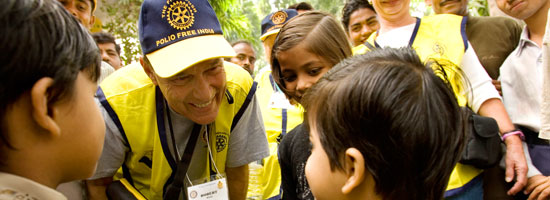
Rotarian Robert Hall greets children who will be vaccinated against polio during a National Immunization Day. Moradabad, India. Photo by Alyce Henson / Rotary Images.
POLIO IS:
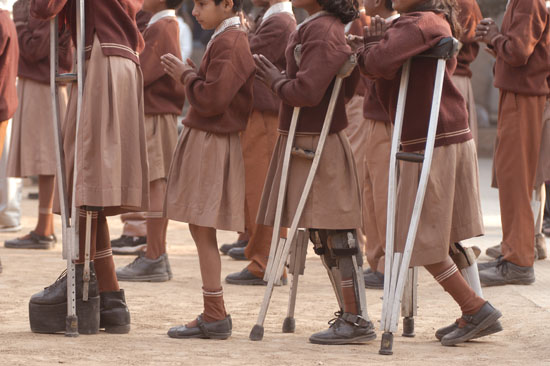
- A crippling and potentially fatal infectious disease, polio (poliomyelitis) still strikes children mainly under the age of five in countries in Asia, Africa, and the Middle East.
- Polio can cause paralysis and sometimes death. Because there is no cure for polio, the best protection is prevention. For as little as US$0.60 worth of vaccine, a child can be protected against this crippling disease for life.
- It can cause paralysis within hours, and polio paralysis is almost always irreversible.
- In the most severe cases, polio attacks the motor neurons of the brain stem, causing breathing difficulty or even death.
- Historically, polio has been the world’s greatest cause of disability.

Did you know that more than 10 million children will be paralyzed in the next 40 years if the World fails to eradicate polio? Embark on a virtual tour of “Whatever Happened to Polio?” an exhibit of the Smithsonian’s National Museum of American History that chronicles the history of the disease and efforts to eradicate it. The exhibit is now on permanent display at the Roosevelt Warm Springs Institute for Rehabilitation.
Learn More About Rotary International's Polio Eradication
Programs On YouTube!

Video 1 Video 2 Video 3 Video 4
Four key strategies for stopping poliovirus transmission:
- Routine immunization
High infant-immunization coverage with four doses of oral polio vaccine (OPV) in the first year of life is critical. Routine immunization is essential because it’s the primary way that polio-free countries protect their children from the threat of imported polio.
- National Immunization Days
For decades, Rotary’s PolioPlus program has been one of the driving forces during National Immunization Days, or NIDs. Rotarians are involved in myriad ways before, during, and after an NID, by providing funds for millions of drops of vaccine, promoting upcoming campaigns in the community, distributing vaccine to local health centers, serving as monitors, working with local officials to reach every child, and participating in surveillance efforts.
- Surveillance
Rotarians play an important role in working with health workers, pediatricians, and others to find, report, and investigate cases of acute flaccid paralysis in timely manner (ideally within 48 hours of onset). PolioPlus sometimes helps fund containers that preserve the integrity of stool samples during transport to laboratories. The program has also played a leading role in providing equipment for the global poliovirus laboratory.
- Targeted mop-up campaigns
Rotary’s support of mop-up campaigns is similar to NID volunteering, but on a smaller, often “house-to-house,” scale.
Challenges to Polio Eradication
Health experts agree that these primary challenges must be overcome in order to reach the goal of polio eradication:
- Halting the spread of the poliovirus in the four remaining endemic countries (Afghanistan, India, Nigeria, and Pakistan), which continue to export it to polio-free areas
- Curbing the intense spread of the poliovirus in northern Nigeria and western Uttar Pradesh, India
- Rapidly stopping polio outbreaks in previously polio-free countries
- Addressing low routine-immunization rates and surveillance gaps in polio-free areas
- Maintaining funding and political commitment to implement the eradication strategies
|
|


 print this page